
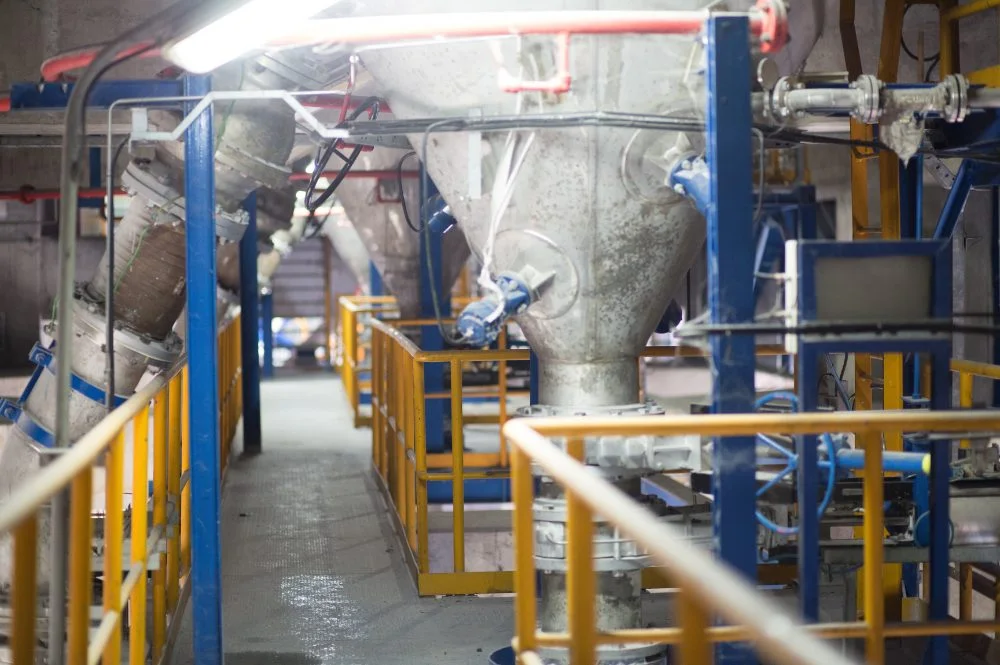
A worker walking backward while carrying material at a mezzanine edge does not have time to clip into anything. That is the scenario passive fall protection is built for. It does not depend on the worker remembering a step, wearing the right gear, or reacting correctly in the moment. It simply stays in place and does its job.
This article looks at where passive fall protection fits inside OSHA’s hierarchy of controls, how it differs from active and administrative approaches, and how Intrepid’s gate and toeboard systems function as the engineering control layer on the plant floor.
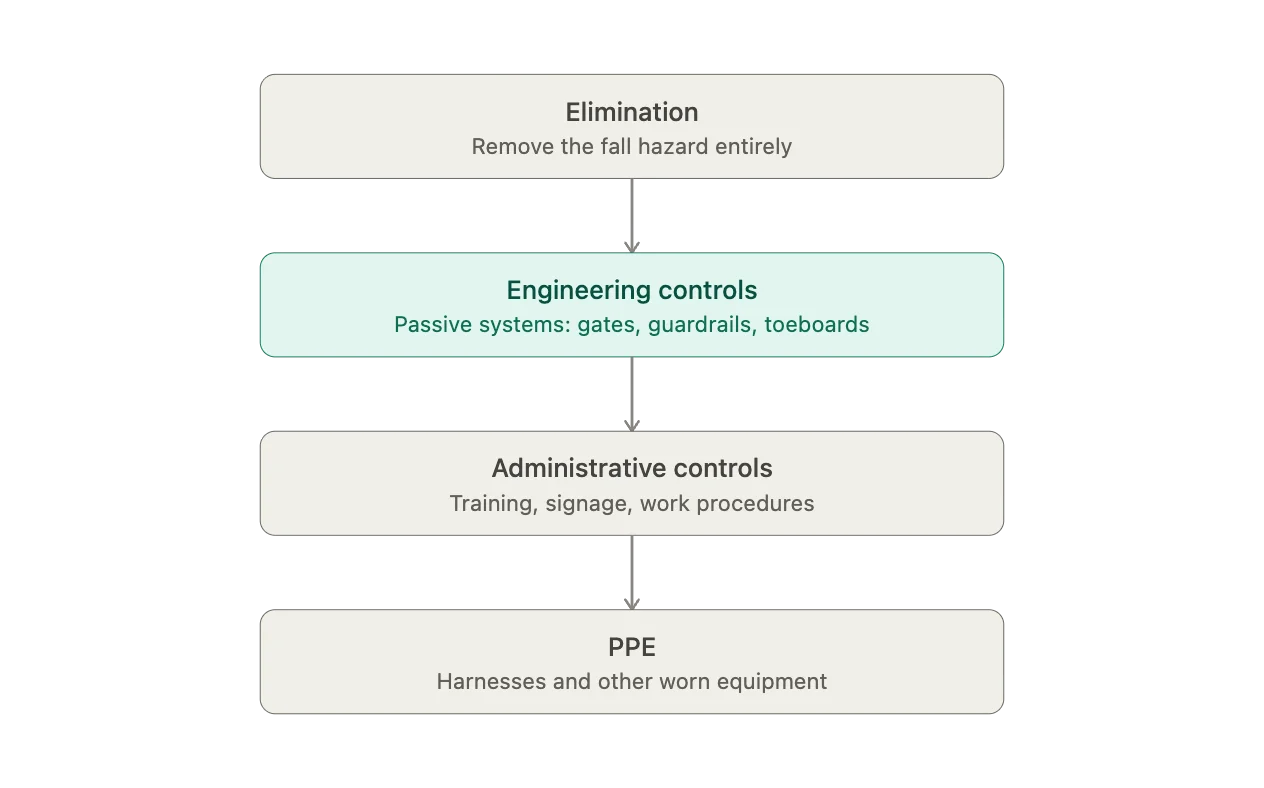
OSHA and most industrial safety programs organize hazard controls into a hierarchy. The order matters because it reflects reliability, not preference. Controls higher in the hierarchy remove risk from the environment. Controls lower in the hierarchy depend on human behavior to work correctly.
The order runs:
Each tier down the list requires more from the worker and gives fewer chances to catch a mistake before it becomes an injury. This is the reasoning behind why OSHA and safety engineers favor higher tiers whenever a hazard can be controlled that way.
Passive fall protection refers to a physical barrier or system that stays in place and functions without requiring the worker to take an action. A guardrail does not need to be worn. A self-closing gate does not need to be latched by hand. A toeboard does not need to be checked before a shift starts. These systems are always active, whether or not anyone is thinking about them.
This is the defining difference between passive fall protection systems and active systems. Active systems, including personal fall arrest equipment, depend on correct use every time. A harness that is not worn, or a lanyard that is not clipped, provides no protection at all. A passive system does not have that failure point built into daily use.
Because of this reliability difference, passive fall protection systems generally sit in the engineering controls tier of the hierarchy, one level above administrative controls and two levels above PPE.
Industrial fall protection generally falls into a few recognizable categories:
Passive fall protection solutions belong in the second category. They are the physical layer that stands between a worker and an opening, edge, or elevated surface, and they function the same way on every shift, with every worker, regardless of training level or attentiveness that day.
Fixed ladder openings, mezzanine edges, catwalks, roof access points, and elevated work platforms all create the same underlying problem: a gap in an otherwise protected walking surface. OSHA 1910.29 addresses this directly, and OSHA 1910.28 sets general requirements for fall protection at unprotected edges and openings four feet or more above a lower level in general industry.
A self-closing gate restores the guardrail line automatically after a worker passes through the opening. A toeboard prevents tools and loose material from being kicked or knocked off an elevated surface onto workers or equipment below. Neither depends on memory, training reinforcement, or personal diligence to function correctly.
Intrepid® manufactures its Universal Gravity-Closing Safety Gate, or UDG, as a passive engineering control for elevated fall protection. The UDG uses gravity, not springs, to return to the closed position after a worker passes through. With fewer mechanical components to maintain, the design holds up in refineries, offshore platforms, petrochemical facilities, and manufacturing plants where corrosion, temperature swings, and heavy use wear down conventional hardware quickly.
The gate is manufactured from polyurethane, resists corrosion, and can be field cut to fit specific opening dimensions. Standard sizes include 22″, 27″, 32″, and 37″ openings, and the UDG is built in a double-bar configuration only. Standard mounting hardware is hot-dip galvanized, with stainless hardware used in Intrepid’s optional No-Drill Mounting Kits. A HoldTight™ Magnet Kit is available for facilities that need additional resistance to gate movement in high-wind conditions.
Intrepid’s toeboards serve the same passive role for dropped object prevention, closing the gap at the base of elevated platforms and walkways where materials and tools present a falling hazard to anyone working or walking below.
It is worth noting that not every gate on an industrial site serves the same purpose. Intrepid’s Pedestrian Barrier Gates are built for ground-level pedestrian and forklift traffic control, not elevated fall protection, and should not be confused with the UDG when evaluating fall protection requirements for a facility.
OSHA fall protection requirements are not optional guidance. Under 1910.29, ladderway floor openings must be protected by a self-closing gate or an equivalent method that prevents an employee from walking directly into the opening. Under 1910.28, employers must protect employees on walking-working surfaces with an unprotected edge four feet or more above a lower level.
For facilities working internationally or in marine and offshore settings, EN ISO 14122 and ABS Standard 201 Section 4.8 may also apply, depending on the vessel or platform classification. Confirming which standard governs a specific installation is a necessary step before specifying equipment, since compliance requirements vary by facility type and jurisdiction.
Passive fall protection is not a single product decision. It is a facility-wide review of every ladder opening, mezzanine edge, and elevated platform where a physical barrier could replace a procedure or a piece of worn equipment. Engineering controls close the gaps that training and PPE cannot fully cover on their own.
Request application guidance or a facility-specific fall protection review with Intrepid®.
Passive fall protection systems, such as guardrails and self-closing gates, function without any action from the worker. Active fall protection systems, including personal fall arrest systems and fall restraint systems, require a harnessed worker to correctly anchor a lanyard or lifeline every time they enter a hazard area. The main difference comes down to human interaction. A passive barrier stays in place on its own. An active system only works if it is worn, adjusted, and connected correctly, which introduces more chances for error.
Common examples of passive protection include guardrail systems, self-closing safety gates at ladderways and floor holes, and toeboards along elevated platforms. Warning line systems and controlled access zones are sometimes grouped with passive measures as well, though they function more as administrative boundaries than physical barriers.
Where OSHA regulations apply, protection is mandatory, not optional. Under general industry rules, employers must protect walking-working surfaces with an unprotected edge and must guard ladderway floor openings with a self-closing gate or equivalent barrier. Passive fall protection systems are one accepted way to meet these fall protection requirements, and OSHA’s fall safety hierarchy favors engineering controls like these over administrative measures or personal protective equipment alone.
Yes. Most fall protection programs use a layered approach. Passive systems handle fixed, predictable hazards such as ladder openings and platform edges, while active fall arrest systems, including a full body harness connected to an anchor point, cover tasks where a physical barrier is not practical, such as work near a leading edge or temporary elevated work.
Passive protection removes the chance of human error from daily operation. A personal fall arrest system depends on proper training, proper use, and consistent inspection of specialized equipment such as lanyards, energy absorbers, and self-retracting lifelines. If any part of that chain is missed, the worker has a false sense of security without real protection. A passive barrier does not carry that same dependency, which is why it sits higher on the fall safety hierarchy.
No. A rescue plan is primarily tied to active fall arrest scenarios, since a suspended worker after a fall arrest event needs a defined path to rescue. Passive systems are designed to prevent the fall from happening in the first place, which is a different safety factor than arresting one in progress. Facilities using both passive and active systems should maintain a rescue plan for any area still relying on personal fall arrest equipment.