
A forklift operator backing out of a rack aisle is watching the load, the mast, and a wide rear swing radius all at once. A worker stepping out from behind the end of that rack usually has a second or two of warning, if that. Most forklift pedestrian safety problems show up in the same places: intersections, blind corners, dock doors, break room exits, and anywhere forklift traffic and pedestrians share the same workspace.
The stakes are well documented. Long-cited OSHA estimates put forklift-related accidents at roughly 85 deaths, 34,900 serious injuries, and 61,800 non-serious injuries each year in the United States (ANSI). Powered industrial trucks also ranked eighth on the Occupational Safety and Health Administration’s list of most frequently cited standards for fiscal year 2025 (OSHA Top 10).
OSHA regulations address these hazards through specific, mandatory requirements. Training and safety rules are vital, but the most effective ways to improve warehouse pedestrian safety are physical controls that separate people from lift trucks or stop people at the point of conflict. This guide covers the OSHA requirements that apply, five engineering controls worth evaluating, a practical scenario, and a free toolbox talk you can run at your next shift meeting.
OSHA forklift pedestrian safety requirements for general industry come mainly from two workplace safety regulations: 29 CFR 1910.178, Powered Industrial Trucks, and 29 CFR 1910.176, Handling Materials. Neither one names a specific barrier product. Both place enforceable obligations on employers wherever forklift operation and foot traffic overlap.
| Requirement | Citation | What it means on the floor |
|---|---|---|
| Sufficient safe clearances must be allowed for aisles, loading docks, doorways, and wherever turns or passage must be made | 1910.176(a) | Every equipment aisle and crossing has to be laid out for the trucks actually in use, including turning room |
| Aisles and passageways must be kept clear, and permanent aisles and passageways must be appropriately marked | 1910.176(a) | Staged pallets in pedestrian walkways or worn-off floor lines are compliance problems, not housekeeping details |
| Operators must be trained and evaluated before operating a truck, and the employer must certify that training | 1910.178(l)(1), (l)(6) | OSHA does not issue forklift licenses; the employer is responsible for training, evaluating, and certifying each operator |
| Operator training must cover pedestrian traffic, narrow aisles, and other restricted places where the truck will be operated | 1910.178(l)(3)(ii)(D), (E) | Training has to reflect your facility’s foot traffic and layout, not just generic truck operation |
| Refresher training is required after unsafe operation, an accident or near miss, or a workplace change that could affect safe operation | 1910.178(l)(4)(ii) | A new crossing, a rerouted aisle, or a near miss triggers retraining |
| Each operator’s performance must be evaluated at least once every three years | 1910.178(l)(4)(iii) | Evaluation is ongoing, not a one-time event |
| Trucks shall not be driven up to anyone standing in front of a bench or other fixed object | 1910.178(m)(1) | Workers at benches, racks, and walls cannot be pinned by an approaching truck |
| No person may stand or pass under the elevated portion of any truck, loaded or empty | 1910.178(m)(2) | Pedestrians stay clear of raised forks and any elevated load |
| Operators must slow down and sound the horn at cross aisles and other locations where vision is obstructed | 1910.178(n)(4) | Blind spots and blind corners need both operator behavior and site design that supports it |
| Operators must look in the direction of travel and keep a clear view of the path; if the load blocks the driver’s view, travel with the load trailing | 1910.178(n)(4), (n)(6) | Clear visibility is a requirement, not a preference |
| Authorized plant speed limits must be observed, and trucks must be operated at a speed that permits a safe stop | 1910.178(n)(1), (n)(8) | Excessive speed near pedestrians is a citable condition, so posted limits should match each zone |
Where a recognized hazard is not covered by a specific standard, OSHA can also cite employers under the General Duty Clause, Section 5(a)(1) of the Occupational Safety and Health Act. OSHA guidelines and eTools add helpful practices, but the regulations above are the enforceable baseline.
Notice what most of these rules have in common. They depend on someone doing the right thing at the right moment: an operator sounding the horn, a pedestrian staying in the marked lane. The hierarchy of controls ranks engineering controls ahead of training and procedures for that reason. Physical pedestrian safety systems keep working when people are tired, rushed, or distracted.
Good warehouse safety rarely comes from a single device. The layouts that reduce accidents most reliably combine several layers: controls that stop people at the point of conflict, barriers that keep them in protected lanes, and visibility aids that give operators time to react.
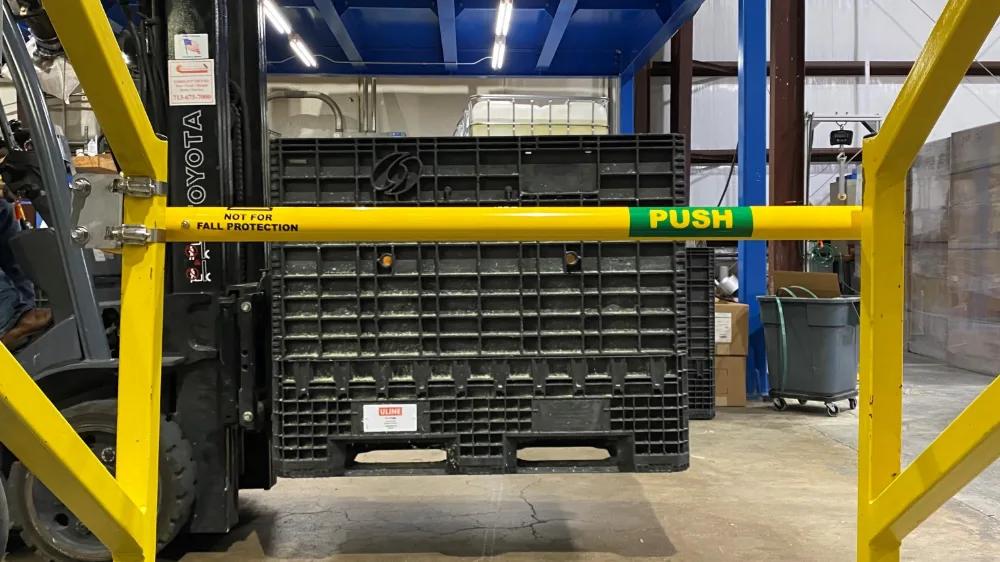
A painted crosswalk tells a worker where to cross. It does nothing to stop someone looking at a phone, a pick list, or the clock. A pedestrian barrier gate puts a physical stop at the exact spot where pedestrian walkways meet forklift traffic, so every crossing starts with a deliberate action instead of a habit.
Intrepid® Pedestrian Barrier Gates are designed for ground-level pedestrian access control in warehouses, distribution centers, manufacturing plants, loading areas, equipment corridors, and other high traffic areas. They are not fall protection products; they are built to control foot traffic at floor level.
For busy crossings, the optional Visual Warning Kit adds a strobe light that activates when the gate is opened. Distracted drivers and equipment operators get a visible signal that someone is entering the lane, which supports the slow-down and horn requirements of 1910.178(n)(4).
Where people travel alongside forklift routes for any distance, permanent guardrails, bollards, or protective fencing keep pedestrians inside designated walkways and trucks outside them. They matter most near rack ends, dock approaches, and building columns, where operators make tight turns and the rear swing is hardest to judge. Openings in these barriers become the crossing points that gates should control.
Floor marking is a baseline requirement under 1910.176(a). Use high-visibility striping or heavy-duty floor tape in a consistent color scheme, keep it visible as it wears, and keep walkways unobstructed. Route pedestrian walkways so workers are not tempted to cut through racking; a path that adds two minutes to the walk to the break room will be ignored.
Convex mirrors at blind corners and doorways let operators and pedestrians see around obstructions before they commit. Organized storage helps too; pallets stacked at aisle ends create blind spots that no mirror can fix. Lighting matters as well—see the above Visual Warning Kit— and OSHA requires auxiliary directional lighting on the truck where general lighting is less than 2 lumens per square foot under 1910.178(h)(2).
Truck-mounted warning lights, backup alarms, and other audible alarms add another layer. In loud facilities, alarms can blend into background noise, so many sites pair them with floor-projected lights or pedestrian detection and proximity warning systems that alert operators when someone is nearby.
The fewest conflicts happen where pedestrians and trucks rarely meet. Look for ways to cut crossings: one-way truck aisles, separate pedestrian doors at docks, and pedestrian-free zones during peak loading. Then set clear pedestrian rules and traffic rules for the areas that remain shared.
Many facilities post stop signs at key intersections and require a complete stop before entering. A written right-of-way policy, such as requiring operators to yield to pedestrians in marked crossings, removes guesswork. Zone-specific speed limits should be set deliberately and posted where operators can see them, since OSHA requires operators to observe authorized plant speed limits under 1910.178(n)(1). Regular audits of these zones help catch potential hazards before they become incidents.
The following is an illustrative scenario based on a common layout problem, not a specific customer account.
A regional distribution center runs two shifts with a main forklift aisle between the pick-and-pack area and the break room. The crossing is marked with yellow floor striping and a pedestrian sign. At each shift change, 40 or more workers cross that aisle within a few minutes while reach trucks and counterbalance lift trucks keep moving loads to the docks.
The safety manager reviews the near-miss log and finds the same pattern repeated. Workers walk straight across without stopping, often while talking or checking phones. Forklift operators coming off the rack aisle have their view partly blocked by the end-of-aisle upright, and some carry speed from the long straightaway into the crossing. Everyone is trained; the crossing still depends on perfect behavior from both sides.
The team makes four changes:
The result is a crossing that no longer relies on memory. Pedestrians pause by design, operators get a visual cue they cannot easily miss, and supervisors have a clear standard to enforce.
Use this forklift pedestrian safety toolbox talk at a shift start or safety meeting. It takes about 10 minutes. Walk the group to a real crossing point if you can; workers remember what they see on their own floor.
Topic: Working safely around forklifts
Why it matters: A loaded forklift can weigh several tons, steers from the rear, and often has a restricted driver’s view. Most pedestrian strikes happen at intersections, rack ends, and dock areas where people and trucks meet without warning. Keeping pedestrians safe is a shared responsibility between operators, pedestrians, and supervisors.
Safety tips for pedestrians:
Safety tips for forklift operators:
Discussion questions:
Close the talk by recording attendance and any hazards raised. Encourage near-miss reporting without blame; the near misses people report are the clearest warning of where accidents will happen next.
| Date | Location | Supervisor | Attendees | Hazards reported |
|---|---|---|---|---|
OSHA requires clear aisles, marked walkways, trained operators, and safe travel practices. Those rules set the minimum for occupational safety. The crossings where people and trucks actually meet are where a physical barrier does the most to prevent accidents, because it works on the busiest shift and the worst day.
If your facility has a crossing that depends on a painted line and good intentions, start there. As next steps, review Intrepid® Pedestrian Barrier Gates and the Visual Warning Kit, then request a quote or talk through your crossing layout with the Intrepid® team.